



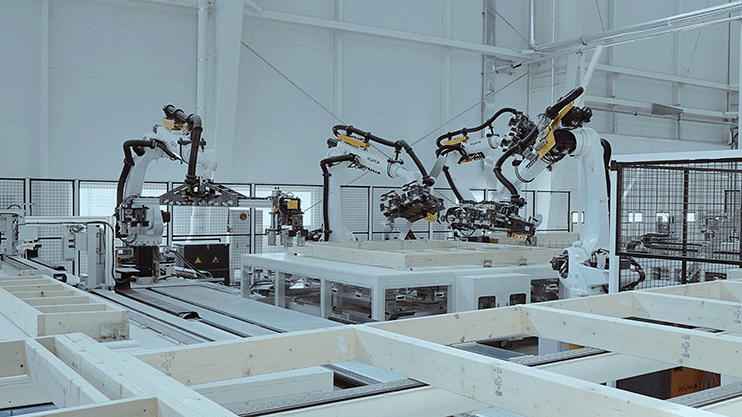
Process layout
Project Overview
This case marks Korea’s first automated solution for modular housing window assembly, combining a KUKA industrial robot, a custom-designed robotic gripper, and a High Payload Track Motion system.
Space Factory introduced this automation system to reduce construction costs and ensure consistent quality in modular housing production.
Background & Objective
Traditionally, skilled workers manually assembled window frames on-site, which was time-consuming and labor-intensive. Meeting diverse client requirements also demanded a large workforce. In addition, the wide and complex work environment made real-time monitoring and process control difficult.
The goal of this project was to automate the window assembly process to significantly reduce work time, establish a standardized production system for consistent quality, and enhance process management through real-time production monitoring.
Components
| Robot | KUKA KR 210 R3100 Industrial Robot
With a maximum payload of 210kg and a working radius of 3,065mm, this robot is optimized for heavy-duty, high-precision operations. |
|---|---|
| Peripherals | These enable precise alignment and movement of wooden materials, automatic assembly of upper and lower window components, and transport of completed frames. |
Workflow
| STEP 1. | Material Input : Wooden materials are accurately aligned and transported using the custom-designed robotic gripper. |
|---|---|
| STEP 2. | Window Assembly : Based on a modular production system, upper and lower window components are assembled automatically. |
| STEP 3. | Frame Transfer : Completed wooden frames are safely and precisely moved by the robot. |
Features
Flexible Assembly:
Capable of assembling 42 different window patterns, allowing for customized modular production.Automated Process & Monitoring:
Real-time monitoring of robot operations enables rapid issue response and efficient process management.
Results
| Key Benefits | Increased Efficiency:
Compared to manual labor, work time was reduced by 30–40%, greatly improving productivity.
Cost Savings:
Standardized production and lower defect rates led to reduced construction costs.
Stable Quality:
Automation ensures consistent housing quality regardless of worker experience.
Mass Production Capability:
A small team can mass-produce a wide range of wooden housing windows in a short period. |
|---|---|
| Client Feedback | Space Factory commented:
"By automating the window assembly process, we were able to maintain consistent quality while significantly reducing construction time and cost. The real-time monitoring system powered by SOLlink Industrial has enabled us to manage production processes more efficiently and respond to issues on the ground with greater agility." |
Unauthorized copying or reproduction of any content on Marosol may violate the Unfair Competition Prevention Act and Copyright Act.
Recommended Solution

Full automation of injection molding line logistics with AMR logistics robots
Process Overview This case study demonstrates an inline logistics solution that utilizes the Yujin Robot GoCart180 and an upper conveyor module to automatically transport plastic injection products from the injection molding machine to the shipping facility. By developing a conveyor module tailored to the customer's production line, we automated product loading and unloading, achieving complete automation throughout the entire inline transport process without operator intervention. Warranty Period 1 Year Performance Year 2023 Project Duration Need for consultation Project Background and Objectives Injection molding manufacturing in-line labor shortage Factory operations are disrupted due to difficulties securing workers Workers avoid work due to the risk of musculoskeletal disorders and industrial accidents

Successfully automated the Samlak heat treatment loading process!🙌 We even built a perfect jig design. (ft. Hyundai Robotics Industrial Robot)
Process Overview This project involved the introduction of automated loading/unloading to ensure uniform heat treatment of the carrier mid-planet , a key component of automotive transmissions. The client implemented automation to address several issues arising from the previously manual process, particularly the increased defect rate and inefficiencies caused by worker s. Hyundai Robotics' HH050 six-axis industrial robot was utilized for this purpose, automating various tasks such as product stacking, pin insertion, and tray placement , ensuring high productivity and stability. Warranty Period 1 Year Performance Year 2024 Project Duration 3 Months

Automated Electric Vehicle Console Assembly with EPSON SCARA Robots! 🦾
Process Overview Bigwave Robotics (Marosol) established an automated assembly line for console parts for Kia Motors' newly launched SUV-type electric vehicle. The existing console assembly line is a large-scale assembly line, requiring an average of 40-60 workers to assemble manually. The lack of automation experience presented challenges in securing space and recruiting assembly workers. Frequent staff turnover and resulting skill level issues hindered productivity. To address this, the company replaced some workers with robots, addressing the labor shortage and consistently ensuring productivity by adapting to the changing workforce. Warranty Period 1 Year Performance Year 2024 Project Duration 4 Months Project Background and Objectives Building a multi-product automated production line and reducing labor costs through robotic automation Preventing mis-assembly and mis-assembly using a lot-of-lot system and ensuring traceability Remote control and integrated management using SOLlink
Process layout
Project Overview
This case marks Korea’s first automated solution for modular housing window assembly, combining a KUKA industrial robot, a custom-designed robotic gripper, and a High Payload Track Motion system.
Space Factory introduced this automation system to reduce construction costs and ensure consistent quality in modular housing production.
Background & Objective
Traditionally, skilled workers manually assembled window frames on-site, which was time-consuming and labor-intensive. Meeting diverse client requirements also demanded a large workforce. In addition, the wide and complex work environment made real-time monitoring and process control difficult.
The goal of this project was to automate the window assembly process to significantly reduce work time, establish a standardized production system for consistent quality, and enhance process management through real-time production monitoring.
Components
| Robot | KUKA KR 210 R3100 Industrial Robot
With a maximum payload of 210kg and a working radius of 3,065mm, this robot is optimized for heavy-duty, high-precision operations. |
|---|---|
| Peripherals | These enable precise alignment and movement of wooden materials, automatic assembly of upper and lower window components, and transport of completed frames. |
Workflow
| STEP 1. | Material Input : Wooden materials are accurately aligned and transported using the custom-designed robotic gripper. |
|---|---|
| STEP 2. | Window Assembly : Based on a modular production system, upper and lower window components are assembled automatically. |
| STEP 3. | Frame Transfer : Completed wooden frames are safely and precisely moved by the robot. |
Features
Flexible Assembly:
Capable of assembling 42 different window patterns, allowing for customized modular production.Automated Process & Monitoring:
Real-time monitoring of robot operations enables rapid issue response and efficient process management.
Results
| Key Benefits | Increased Efficiency:
Compared to manual labor, work time was reduced by 30–40%, greatly improving productivity.
Cost Savings:
Standardized production and lower defect rates led to reduced construction costs.
Stable Quality:
Automation ensures consistent housing quality regardless of worker experience.
Mass Production Capability:
A small team can mass-produce a wide range of wooden housing windows in a short period. |
|---|---|
| Client Feedback | Space Factory commented:
"By automating the window assembly process, we were able to maintain consistent quality while significantly reducing construction time and cost. The real-time monitoring system powered by SOLlink Industrial has enabled us to manage production processes more efficiently and respond to issues on the ground with greater agility." |
Unauthorized copying or reproduction of any content on Marosol may violate the Unfair Competition Prevention Act and Copyright Act.
Recommended Solution
Full automation of injection molding line logistics with AMR logistics robots
Process Overview This case study demonstrates an inline logistics solution that utilizes the Yujin Robot GoCart180 and an upper conveyor module to automatically transport plastic injection products from the injection molding machine to the shipping facility. By developing a conveyor module tailored to the customer's production line, we automated product loading and unloading, achieving complete automation throughout the entire inline transport process without operator intervention. Warranty Period 1 Year Performance Year 2023 Project Duration Need for consultation Project Background and Objectives Injection molding manufacturing in-line labor shortage Factory operations are disrupted due to difficulties securing workers Workers avoid work due to the risk of musculoskeletal disorders and industrial accidents
Successfully automated the Samlak heat treatment loading process!🙌 We even built a perfect jig design. (ft. Hyundai Robotics Industrial Robot)
Process Overview This project involved the introduction of automated loading/unloading to ensure uniform heat treatment of the carrier mid-planet , a key component of automotive transmissions. The client implemented automation to address several issues arising from the previously manual process, particularly the increased defect rate and inefficiencies caused by worker s. Hyundai Robotics' HH050 six-axis industrial robot was utilized for this purpose, automating various tasks such as product stacking, pin insertion, and tray placement , ensuring high productivity and stability. Warranty Period 1 Year Performance Year 2024 Project Duration 3 Months
Automated Electric Vehicle Console Assembly with EPSON SCARA Robots! 🦾
Process Overview Bigwave Robotics (Marosol) established an automated assembly line for console parts for Kia Motors' newly launched SUV-type electric vehicle. The existing console assembly line is a large-scale assembly line, requiring an average of 40-60 workers to assemble manually. The lack of automation experience presented challenges in securing space and recruiting assembly workers. Frequent staff turnover and resulting skill level issues hindered productivity. To address this, the company replaced some workers with robots, addressing the labor shortage and consistently ensuring productivity by adapting to the changing workforce. Warranty Period 1 Year Performance Year 2024 Project Duration 4 Months Project Background and Objectives Building a multi-product automated production line and reducing labor costs through robotic automation Preventing mis-assembly and mis-assembly using a lot-of-lot system and ensuring traceability Remote control and integrated management using SOLlink